The REAL Change in Our Climate: Broken Water Cycles
Walk under a shade tree and it feels cool, because of the shade, but also because of evaporating water. This is the key to understanding climate change.
Dear Friends,
Here is a description I wrote for the upcoming Water & Climate course. Registration is not open just yet, but I hope you will look it over and consider taking the course in July.
Here is the description:
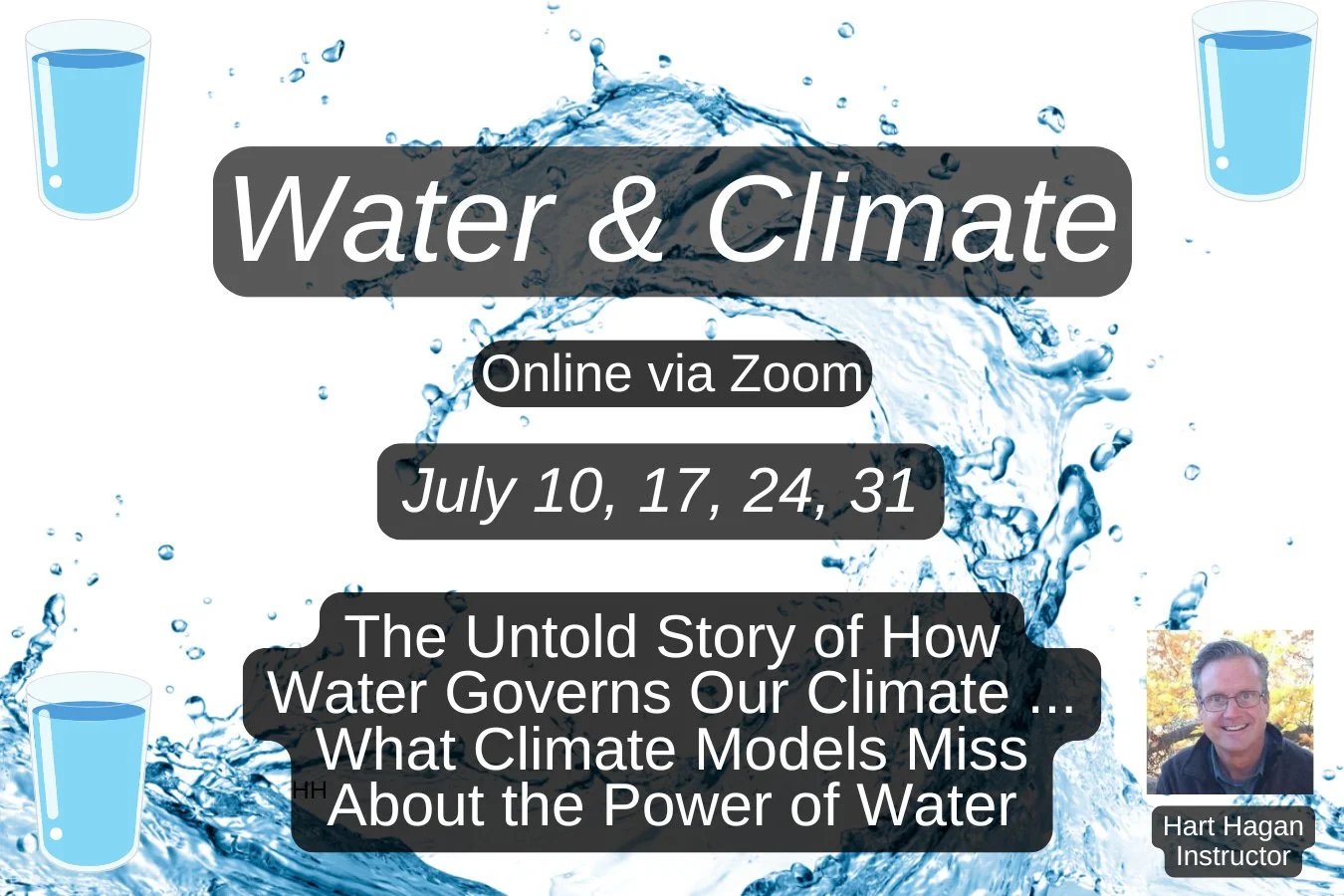
Water & Climate (the course) tells the untold story of how water governs our climate and reveals what high profile climate models miss about the power of water.
This is a course about how you can make a real difference. But be forewarned, this course may challenge your fundamental understanding of climate change.
We assert that climate change is not just about greenhouse gases, but about what we do to the land, in our homes and communities, farms and forests, mountains and deserts.
The Cooling Power of Evaporating Water
Step out of the shower or the swimming pool. You feel cold. Why? Because water is evaporating off your skin. When you exercise, you sweat and feel cool as water evaporates from your skin.
This is the cooling power of evaporating water, which operates everywhere, worldwide, all the time.
95% of Earth’s Heat Dynamics
Some say water governs 95% of heat dynamics on earth. Some say it’s only 60%. But how can we understand global warming without understanding the substance responsible for over half of our heat transfer?
When water evaporates or condenses, that’s a transfer of heat. When water flows from place to place as a liquid or a vapor, that’s a transfer of heat. Water is currently cooling and warming your body-- distributing heat from where it is to where it’s needed. The same is true for all living systems, e.g., ecosystems.
Ecosystems will do the work of heat transfer, if we let them. But too often we degrade and destroy our ecosystems, thereby defeating their ability to cool their surroundings.
Call to Action: Increase Plant Cover by 10%
Consider this: If we were to increase our plant cover by 10%, we could eliminate global warming altogether.
Here’s how that would work.
Land is 30% of the earth’s surface. So increasing plant cover by 10% on land would increase plant cover overall by 3%.
This 3% increase in plant cover would increase cooling, in at least three ways: 1) by increasing the shade from cloud cover, because plants and trees create clouds, 2) by increasing the shade from the plant cover itself, and 3) by increasing the evaporation of water from plants.
(Note well: The greenhouse effect represents only a 1% excess of incoming heat over outgoing heat. So if we can deal with that 1%, then we will have eliminated the greenhouse effect.)
As a Practical Matter, How Can We Increase Plants?
We could harness the cooling power of plants by allowing our forests to grow, instead of continually cutting them down, as we do now. We could increase plant cover on our farms, by encouraging the use of cover crops. And we could increase plant cover in our mountains and deserts through methods we will explore in class.
We could increase plant cover in our gardens and urban landscapes, by mowing less and prioritizing ecological landscapes over a formal, rigid style.
The great thing is that you can be part of the solution, starting with where you live.
Examples & Role Models
We will travel worldwide (via video) to learn from people using simple, low-cost water retention structures to slow the flow of water and cause it to sink and soak into the ground.
We will study the work of a Wisconsin farmer who travels worldwide helping farmers capture rainfall.
We will study the work of a California beaver advocate who will teach us how to fill gulleys with leaves and limbs, so as to slow the flow of water and cause it to sink and soak into the landscape.
We will visit the people of Senegal to see how they are growing food while stopping the advance of the Sahara desert, by capturing rainfall during the rainy season, and causing it to soak into their gardens and food forests.
We will visit a doctor in India who has restored countless miles of rivers.
Animals are Water Engineers
We will study the ability of animals to rehydrate our landscape. In one of the great untold stories of climate change, animals can serve as ecosystem engineers, thereby restoring our water cycles. This includes dam-building beavers as well as burrowing animals like prairie dogs, moles and earthworms, with the burrows creating tunnels into which rain flows, for later use by plants, animals and the soil food web.
Even cattle--well-managed--can create little pock marks that retain water. And the positive impact of cattle can restore soil, plant communities, water cycles and ecosystems--but only if the animals are well-managed.
What Can a High-Functioning Forest Do?
We will learn that a high-functioning (e.g., old growth) forest drives every stage of the water cycle. A high functioning forest drives evaporation, which contributes to subsequent rain events, sometimes locally and sometimes across the ocean.
A high functioning forest is vital to condensation and cloud formation. And a high functioning forest makes precipitation possible, by providing a cool, moist environment into which rain can more easily fall all the way to the ground, instead of evaporating in the hot, dry air.
A high-functioning forest--or even an average forest--becomes a sponge, soaking up rainfall. It becomes a filter, cleaning water for downstream use. It becomes a heat bank, preventing extreme temperatures. It becomes a solar-powered air conditioner, cooling its environs. It becomes a humidifier, a canopy (umbrella) and a windbreak, protecting the soil from the sun and wind, keeping it moist.
And a functioning forest becomes a habitat for myriad life forms, all of which are made largely of water.
Clear Understanding, with Calls to Action
If you are worried about climate change, this is the course for you, because we will learn how we could restore our climate in a short time.
The Water & Climate course will give you easy calls to action, as well as a unique understanding of how our water-rich world works.
This is a more intuitive and common sense approach to climate change. You will no longer be a spectator, but an actor, and you will be acting upon the most important parts of climate change.
